
The word “balance” shows up everywhere in conversations about modern life, especially for working parents and anyone juggling multiple responsibilities. We’re told to find work-life balance, achieve better balance, create more balance. But here’s what I’ve noticed: the more we chase balance, the more inadequate we feel when life inevitably tips in one direction or another.
Maybe that’s because balance isn’t actually what we’re after. Maybe we’ve been asking the wrong question entirely.
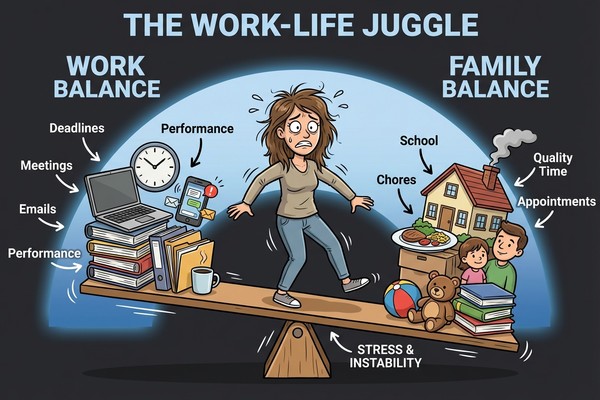
Balance suggests a perfect equilibrium—equal weight on both sides of a scale, everything in its proper place, nothing spilling over. It’s a beautiful image, but it’s also completely static. Real life isn’t static. Your kid gets sick on the day of your big presentation. Your partner needs support during a difficult time at work. A project deadline collides with a family commitment. Life is constantly moving, shifting, requiring different things at different moments.
Balance implies we can control the weight on both sides. Integration acknowledges we’re usually just trying to keep everything from falling apart.
The Trap of Perfect Equilibrium
When we frame our goal as “balance,” we set ourselves up for a particular kind of failure. Every time one area of life demands more attention, we feel like we’re failing at balance. The working mother who stays late to finish a project feels guilty about missing bedtime. The entrepreneur who takes a day off to attend their child’s school event worries about falling behind. The person who prioritizes their health by going to therapy feels selfish for taking time away from family or work.
This framework turns normal life adjustments into moral failures. It suggests there’s a “right” way to distribute our energy and attention, and anything that deviates from perfect equilibrium is somehow wrong.
But what if the problem isn’t our inability to achieve balance? What if the problem is balance itself as a metaphor for how life actually works?
Integration: A Different Way Forward
Integration offers a more honest framework. Instead of seeking perfect balance, integration acknowledges that our various roles and responsibilities are interconnected. They influence each other, support each other, and yes, sometimes compete with each other. The goal isn’t to keep them perfectly separate and equally weighted—it’s to find ways for them to work together as a whole.
Think about it this way: balance suggests you can compartmentalize your life into distinct areas that don’t touch. Integration recognizes that you’re the same person in all these contexts. Your values, your energy, your attention—these don’t magically reset when you switch from “work mode” to “parent mode” to “partner mode.”
When my friend Sarah talks about her day, she doesn’t describe achieving perfect balance. She describes integration: taking a work call while walking her daughter to school, using her lunch break to handle a family logistics issue, bringing lessons from parenting into how she manages her team. Her life isn’t balanced—it’s integrated. The different parts inform and support each other rather than competing for equal time.
This isn’t about blending everything into an indistinguishable mess. Integration can include boundaries, focused time, and intentional separation when needed. But it starts from a place of accepting that your life is interconnected rather than fighting against that reality.
The Role Collision Problem
One of the most exhausting aspects of modern life is what I call “role collision”—those moments when your different identities crash into each other and you feel like you’re failing at all of them simultaneously.
You’re in the middle of an important work conversation when your child’s school calls. You’re trying to be present at a family dinner while your mind races through tomorrow’s deadlines. You want to support your partner through a difficult time, but you’re also managing your own work crisis and feeling like you can’t show up fully for either.
The exhaustion isn’t just from doing multiple things—it’s from pretending they exist in separate worlds.
Traditional advice often focuses on better boundaries or time management. But role collision isn’t really a scheduling problem. It’s an integration problem. When we pretend our various roles don’t influence each other, we create internal conflict. We spend enormous mental energy trying to keep different parts of ourselves separate, when the reality is that they’re all part of the same person living one interconnected life.
Integration doesn’t eliminate role collision, but it reduces the shame and internal conflict around it. Instead of feeling like you’re failing at being a good parent, partner, and professional simultaneously, you can recognize that you’re navigating the normal complexity of a full life.
The Cost of Compartmentalization
The productivity culture often promotes strict compartmentalization—work stays at work, family time is sacred, personal time is protected. While boundaries can be helpful, the extreme version of this thinking creates its own problems.
When we try to completely separate different areas of our lives, we often end up carrying extra mental load. You can’t bring up the family scheduling conflict during your work planning meeting, so you carry that stress silently. You can’t acknowledge work pressures during family time, so you’re physically present but mentally elsewhere. You can’t integrate lessons from one area of life into another, missing opportunities for growth and efficiency.
I’ve watched friends exhaust themselves trying to maintain perfect boundaries between work and family, only to realize they were spending more energy managing the boundaries than they would have spent allowing some natural integration. The working parent who refuses to ever check email during family time but then stays up until midnight catching up. The entrepreneur who won’t discuss business during dinner but carries the stress of unresolved issues throughout the evening.
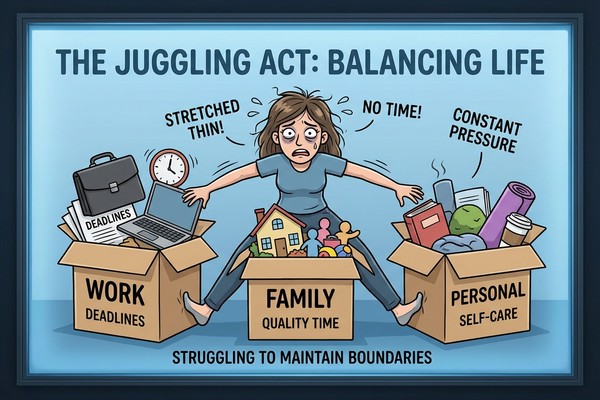
Sometimes integration actually creates more space and less stress than rigid separation. The parent who handles a quick work issue during their child’s soccer practice might be more present for the rest of the game. The professional who brings their child to a casual work meeting might find both roles easier to manage than trying to arrange separate childcare.
A Better Question
Instead of asking “How can I balance everything better?” try asking “What needs support right now?” This shifts the focus from achieving perfect equilibrium to responding to current reality.
Some weeks, work needs more attention because of a crucial deadline or new opportunity. Some seasons, family requires more energy because of health issues, school transitions, or relationship challenges. Some periods, your own well-being needs to be the priority because you’re running on empty.
This isn’t failure—it’s responsiveness. It’s recognizing that life has rhythms and seasons, and trying to maintain identical energy distribution across all areas at all times is both impossible and unnecessary.
When you ask “What needs support right now?” you can make intentional choices about where to focus without the guilt that comes with “falling out of balance.” You’re not failing at balance—you’re succeeding at integration by responding to what your life actually requires in this moment.
Language That Reduces Shame
The words we use to describe our experience shape how we feel about it. Here are some language swaps that can reduce shame and increase self-compassion:
- Instead of “I’m so bad at balance,” try “I’m learning to integrate my priorities”
- Instead of “I’m failing at everything,” try “I’m managing competing demands”
- Instead of “I should be better at this,” try “This is genuinely difficult”
- Instead of “I’m behind,” try “I’m adjusting to current needs”
These aren’t just feel-good phrases—they reflect a more accurate understanding of what you’re actually doing. Managing multiple roles and responsibilities is complex work that deserves recognition, not criticism.
Integration isn’t about doing everything perfectly—it’s about responding to life as it actually is, not as productivity culture says it should be.
Tools That Support Integration
The best tools and systems support integration rather than forcing artificial separation. Instead of trying to manage work, family, and personal tasks in completely different systems, look for approaches that acknowledge the interconnected nature of your life.
This might mean using a single capture system for all your thoughts and tasks, regardless of which “area” they belong to. It might mean scheduling family logistics during work breaks rather than trying to handle them in separate “personal time.” It might mean choosing tools that help you see patterns and connections across different areas of your life rather than keeping them in isolated silos.
The goal isn’t to blur everything together, but to reduce the mental overhead of maintaining artificial boundaries. When your tools work with your integrated reality instead of against it, managing complexity becomes significantly easier.
Integration acknowledges what we all know but rarely admit: our lives are beautifully, messily interconnected. Instead of fighting against that reality in pursuit of perfect balance, we can learn to work with it. We can develop systems, language, and expectations that support our actual lives rather than some idealized version that exists only in productivity blogs.
The relief isn’t in finally achieving balance—it’s in giving yourself permission to stop trying.
This article was created with collaboration between humans and AI—we hope you ❤️ it.