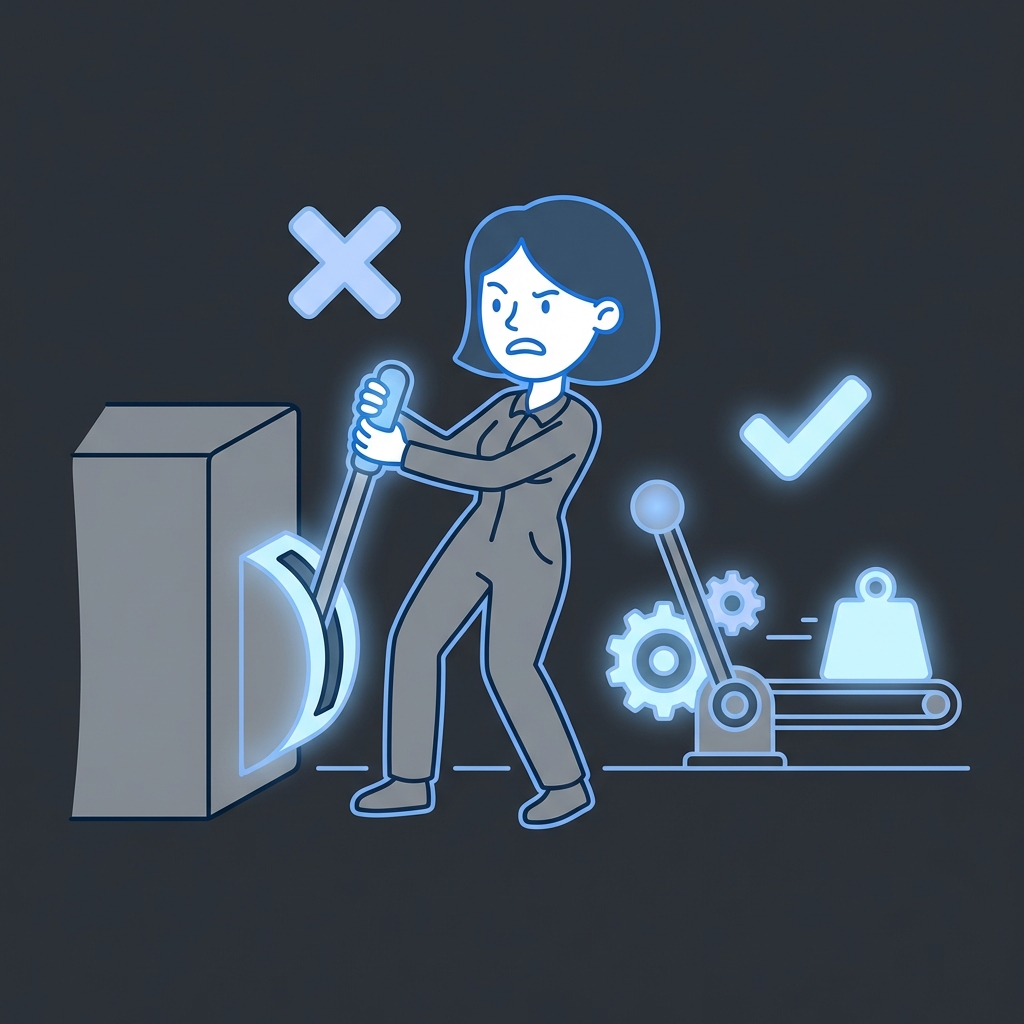
We’ve been sold a myth about willpower. The story goes like this: successful people have more self-control, and if you’re struggling to stick to your goals, you just need to dig deeper and try harder. It’s a seductive narrative because it puts control entirely in your hands. But it’s also completely wrong.
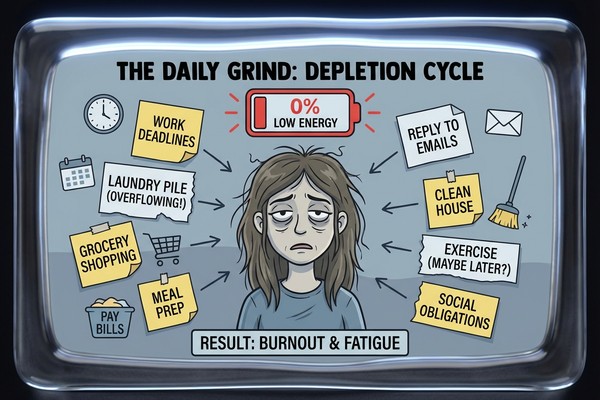
The reality is that willpower operates more like your phone battery than a character trait. It drains throughout the day, gets depleted by stress, and can be completely wiped out by a bad night’s sleep or an unexpected crisis. If you’ve ever found yourself making perfectly reasonable decisions in the morning only to completely abandon them by evening, you’ve experienced this firsthand.
This isn’t a personal failing—it’s human design. And once you understand how willpower actually works, you can stop fighting your own psychology and start working with it instead.
The Myth of Endless Self-Control
The willpower-as-virtue narrative is particularly cruel to working parents and anyone managing complex lives. When you’re juggling work deadlines, family schedules, household management, and trying to maintain some semblance of personal well-being, your cognitive resources are already stretched thin. The last thing you need is another system that depends on you having perfect self-discipline.
Research consistently shows that willpower is finite and context-dependent. A person who exercises incredible restraint at work might come home and mindlessly scroll social media for hours. Someone who meal preps religiously on Sundays might order takeout three nights in a row during a stressful week. These aren’t contradictions—they’re predictable patterns of how mental energy works.
The most interesting finding from behavior science isn’t about willpower at all. It’s about how small environmental changes can create massive behavioral shifts without requiring any additional self-control. When researchers want to increase healthy eating in cafeterias, they don’t give lectures about nutrition. They move the salad bar closer to the entrance and put the desserts further away. When cities want to reduce car accidents, they don’t just tell people to drive more carefully—they redesign intersections.
The most sustainable changes happen when you stop relying on your future self to be more disciplined than your current self.
The Power of Friction
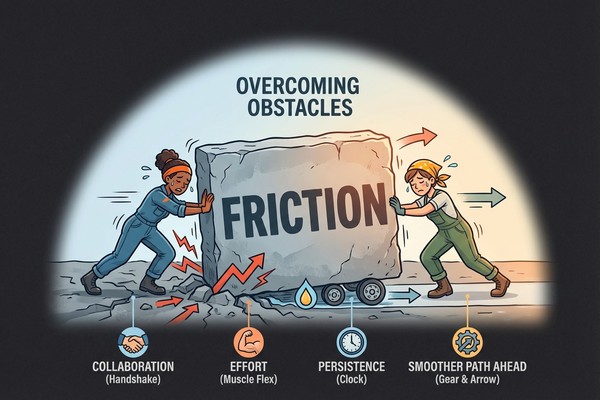
The concept of friction might be the most underutilized tool in personal change. Friction is simply the effort required to take an action—and tiny changes in friction can lead to dramatic differences in behavior.
Want to drink more water? Put a filled water bottle on your desk every morning. Want to exercise more consistently? Lay out your workout clothes the night before. Want to reduce mindless phone scrolling? Move social media apps off your home screen. None of these strategies require superhuman willpower, but they all work by adjusting the path of least resistance.
The inverse is equally powerful. If you want to reduce a behavior, add friction. Put your phone in another room when you’re trying to focus. Use a browser extension that adds a delay before accessing distracting websites. Store tempting snacks in hard-to-reach places. The goal isn’t to make these things impossible—it’s to create just enough pause for your intentional brain to catch up with your automatic one.
Most productivity advice gets this backwards. It focuses on motivation and discipline when the real leverage is in design. A well-designed environment makes good choices feel effortless and poor choices feel cumbersome. Your willpower becomes the backup system, not the primary engine.
Cues, Context, and Environmental Design
Every behavior happens in response to a cue, whether you’re conscious of it or not. The sound of your phone buzzing cues you to check messages. Walking past the coffee shop cues you to consider stopping for a latte. Sitting down at your desk cues you to open your laptop. These environmental triggers are constantly shaping your actions, usually below the level of awareness.
The brilliant insight from behavior science is that you can deliberately design these cues to work in your favor. If you want to read more, place a book on your pillow so you see it when you get into bed. If you want to remember to take vitamins, put the bottle next to your coffee maker. If you want to process emails more efficiently, create a specific workspace that you only use for focused tasks.
This is why changing your environment often works better than changing your mindset. Your physical surroundings are constantly sending signals about what actions are expected, appropriate, or easy. When you align those signals with your intentions, behavior change becomes almost automatic.
The key is specificity. Instead of a vague commitment to “eat healthier,” you might decide that every Sunday you’ll wash and cut vegetables and put them in clear containers at eye level in your fridge. Instead of promising to “be more organized,” you might create a specific landing zone by your front door where keys, wallet, and sunglasses always go.
Why Real Support Actually Works
Social support gets talked about a lot, but most advice misses the crucial distinction between accountability and actual support. Accountability—having someone check whether you did the thing—can actually increase pressure and shame around behavior change. Real support is different. It’s about creating systems that make the desired behavior easier or more sustainable.
Real support might look like a friend who agrees to text you a daily reminder during the first week of a new habit. It could be a family member who takes over bedtime routine on the nights you want to exercise. It might be a colleague who agrees to be your “focus buddy” during deep work sessions, where you both turn off notifications and check in with each other afterward.
The most effective support systems reduce friction rather than adding oversight. They acknowledge that behavior change is hard and that having people in your corner makes it easier, not because they’re watching you, but because they’re actively helping remove barriers.
> The best support systems don’t ask “Did you do it?” They ask “What would make it easier?”
Start Small, Start Now
If you take nothing else from behavior science, take this: the smallest viable action is almost always better than the most ambitious plan. The person who commits to writing one sentence per day is more likely to become a consistent writer than the person who plans to write for two hours every morning. The person who decides to put on workout clothes every day is more likely to develop an exercise habit than the person who signs up for a intensive fitness program.
This isn’t about lowering your standards—it’s about understanding how habits actually form. Consistency beats intensity every time. Small actions repeated regularly create neural pathways that make future actions easier. Grand gestures that require enormous willpower create cycles of effort and burnout.
The magic happens when the behavior becomes automatic enough that it no longer requires decision-making energy. At that point, you can gradually increase intensity or duration. But the foundation has to be built on actions that feel almost too easy to skip.
Designing Systems That Adapt
The most sophisticated approach to behavior change is creating systems that adjust friction dynamically based on your current capacity. This is where tools like Backlit become particularly valuable—they’re designed to hold the cognitive load of remembering and following up, so you don’t have to rely on willpower to manage the system itself.
Traditional productivity systems often add mental overhead. They require you to remember to use them, maintain them, and make decisions about them. But the best systems work in the background, surfacing what’s important when it’s relevant and staying out of your way when it’s not.
Think about how your smartphone automatically adjusts screen brightness based on ambient light, or how your car’s cruise control maintains speed without constant input from you. The most effective behavior change tools operate on similar principles—they reduce the cognitive friction of doing the right thing at the right time.
This is the future of sustainable change: not more willpower, but smarter design. Systems that understand that your capacity varies, that your context matters, and that the goal isn’t to optimize you—it’s to support you in becoming the person you already want to be.
The next time you find yourself frustrated with your own lack of discipline, pause and ask a different question. Instead of “How can I try harder?” ask “How can I make this easier?” The answer might surprise you with how simple it is.
This article was created with collaboration between humans and AI—we hope you ❤️ it.