You know that moment when you’re still mentally composing emails while stirring dinner, or when your partner asks about weekend plans and you’re genuinely confused because you’re still operating in Tuesday-morning-meeting mode? That’s 7:12 PM on a random weeknight—the exact time when your work-self is supposed to magically transform into your home-self, like some kind of professional werewolf in reverse.
We’ve bought into this myth that we can compartmentalize cleanly. Professional by day, human by night. Work-you handles spreadsheets and difficult conversations with grace; home-you makes dinner and listens to your teenager’s drama with infinite patience. They’re supposed to be separate people sharing the same body, switching shifts like well-organized roommates.
But here’s the thing nobody talks about: the handoff is brutal.
The Handoff Hour: When Worlds Collide
The transition from work-self to home-self isn’t a light switch—it’s more like trying to merge onto a highway while the car is still warming up. Your brain is finishing work thoughts, your nervous system is still humming with professional energy, and suddenly you’re expected to care deeply about whose turn it is to take out the trash.
This isn’t a personal failing. It’s a design flaw in how we think about human energy and attention. We act like context-switching between major life roles should be seamless, when in reality, it requires the same kind of intentional transition that athletes use between training and competition.
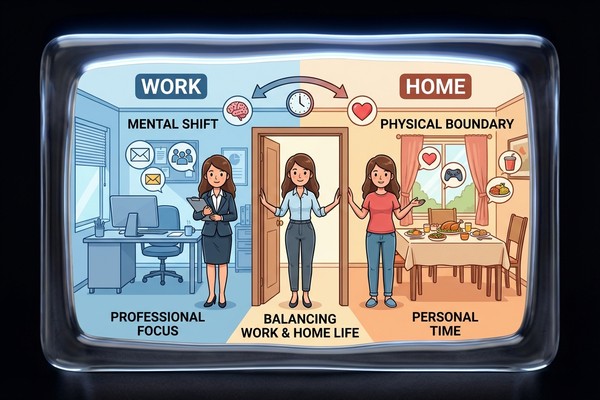
The handoff hour—that murky time between leaving work and fully arriving at home—is where most of our emotional spillover happens. Work stress bleeds into family time. Home chaos infiltrates the next morning’s focus. We’re constantly playing catch-up with our own lives because we never properly closed the loop on the previous context.
Think about your last really difficult workday. Did it end when you logged off your computer? Or did it follow you to the dinner table, making you distracted and irritable with the people who had nothing to do with your 3 PM crisis? Most of us know the answer, and it’s not pretty.
The Real Cost of Switching Selves
The transition between work-self and home-self involves three distinct types of costs that we rarely acknowledge:
Cognitive costs: Your brain needs time to literally rewire itself from one set of priorities to another. The neural pathways that help you navigate office politics are different from the ones that help you navigate bedtime negotiations with a six-year-old.
Emotional costs: Professional composure and personal vulnerability require different emotional settings. You can’t just flip from “diplomatic with difficult clients” to “present with your anxious child” without some kind of emotional recalibration.
Logistical costs: Work-self leaves behind tasks, emails, and half-finished projects. Home-self inherits dinner prep, homework supervision, and household management. The handoff requires actual coordination between these two versions of you.
The transition between work-self and home-self isn’t a light switch—it’s more like trying to merge onto a highway while the car is still warming up.
Most productivity advice completely ignores these costs. “Just leave work at work!” they say, as if you can simply decide to stop caring about the presentation that went sideways or the email you forgot to send. “Be present with your family!” as if presence is a switch you can flip rather than a skill that requires practice and the right conditions.
The advice isn’t wrong—it’s just incomplete. It tells you what to do without acknowledging what it actually takes to do it.
Why “Decompress” Doesn’t Work Without Structure
Here’s where most well-meaning advice falls apart. Everyone knows you need to “decompress” between work and home, but nobody talks about what decompression actually looks like in practice.
Decompression isn’t just flopping on the couch with your phone for twenty minutes. That’s numbing, not transitioning. Real decompression requires intentionally closing mental loops from work while gradually opening yourself to home priorities. It’s active, not passive.
Without structure, most of us end up in transition limbo—not fully present at work during the last hour because we’re thinking about home, not fully present at home during the first hour because we’re still processing work. We’re neither here nor there, just floating in the uncomfortable middle space where both selves feel neglected.
The people who seem to handle work-life transitions gracefully aren’t just naturally better at compartmentalization. They’ve usually developed some kind of system—often unconsciously—that helps them make the handoff more intentional.
Micro-Systems That Actually Work
The most effective transitions aren’t grand gestures or hour-long meditation sessions. They’re small, consistent rituals that signal to your brain and body that one context is ending and another is beginning.
Some examples of transition rituals that actually work:
• The car sit: Sitting in your car for five minutes after arriving home, not scrolling your phone, just letting your nervous system settle • The clothing change: Physically changing clothes as a way to signal role transition (work clothes off, home clothes on) • The brain dump: Writing down three work thoughts that are still circling, then closing the notebook • The gratitude pivot: Naming one thing that went well at work and one thing you’re looking forward to at home
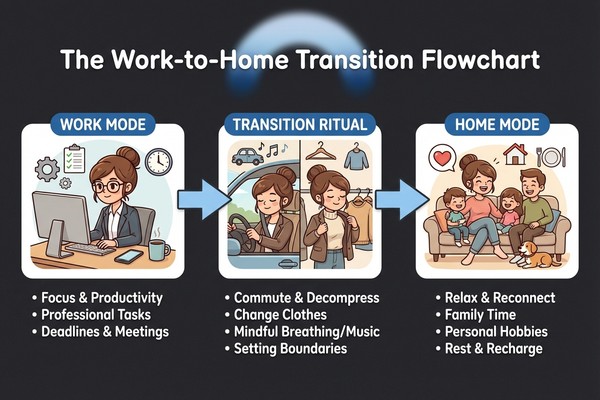
The key is that these rituals serve both selves. They give work-you a sense of completion and home-you a sense of beginning. They’re bridges, not walls.
What Each Self Needs From the Other
Here’s something most productivity advice misses entirely: your work-self and home-self aren’t enemies competing for resources. They’re collaborators who need to take care of each other.
Your home-self needs your work-self to finish strong—to tie up loose ends, communicate clearly about tomorrow’s priorities, and leave the workspace in a state that won’t create morning anxiety. When work-you leaves a mess, home-you pays the price in background worry and mental rehearsal of tomorrow’s problems.
Your work-self needs your home-self to recharge intentionally—to eat well, sleep enough, and engage in activities that restore rather than drain. When home-you stays up too late scrolling or skips meals, work-you shows up depleted and reactive.
Your work-self and home-self aren’t enemies competing for resources. They’re collaborators who need to take care of each other.
This isn’t about perfect balance or optimization. It’s about basic respect between the different versions of yourself who have to share the same body and brain. When one self consistently leaves problems for the other to clean up, the whole system breaks down.
Design Your Own 10-Minute Transition
Right now, think about your typical transition from work to home. What happens in those first ten minutes after you stop working? Are you intentional about it, or do you just let it happen to you?
Here’s a simple framework for designing a transition ritual that actually works:
Minutes 1-3: Close work. This isn’t about finishing everything—it’s about creating a sense of completion with what you’ve done today. Write down tomorrow’s first priority. Close the laptop with intention.
Minutes 4-7: Reset your system. This is where you help your nervous system shift gears. Deep breaths, physical movement, or just sitting quietly. The goal is to let your body catch up with the fact that work is over.
Minutes 8-10: Open to home. Actively shift your attention to home priorities. What does your family need from you tonight? What do you need from this evening? Set an intention, not a to-do list.
The specific activities matter less than the intentionality. You’re creating a bridge between contexts instead of just hoping the transition will happen naturally.
Beyond Individual Willpower
Here’s the bigger picture: the problem isn’t that we’re bad at transitions. The problem is that we’re trying to solve a systems problem with individual willpower.
Most of us are managing the handoff between work-self and home-self completely manually, every single day. We’re using our already-depleted decision-making resources to figure out how to stop thinking about work and start thinking about home. No wonder it feels exhausting.
We’re trying to solve a systems problem with individual willpower.
What if, instead of relying on your tired 7 PM brain to figure out how to transition, you had a system that anticipated these moments and made them easier? What if the handoff between your work-self and home-self was supported by tools that remembered what each version of you needed?
The goal isn’t to become a different person. It’s to become the same person who moves more gracefully between the different roles your life requires. Someone who can be professional and human, productive and present, without constantly feeling like you’re failing at both.
The transition between work and home doesn’t have to be a daily battle. It can be a bridge you build once and cross with confidence, knowing that both sides of your life are getting what they need.
This article was created with collaboration between humans and AI—we hope you ❤️ it.