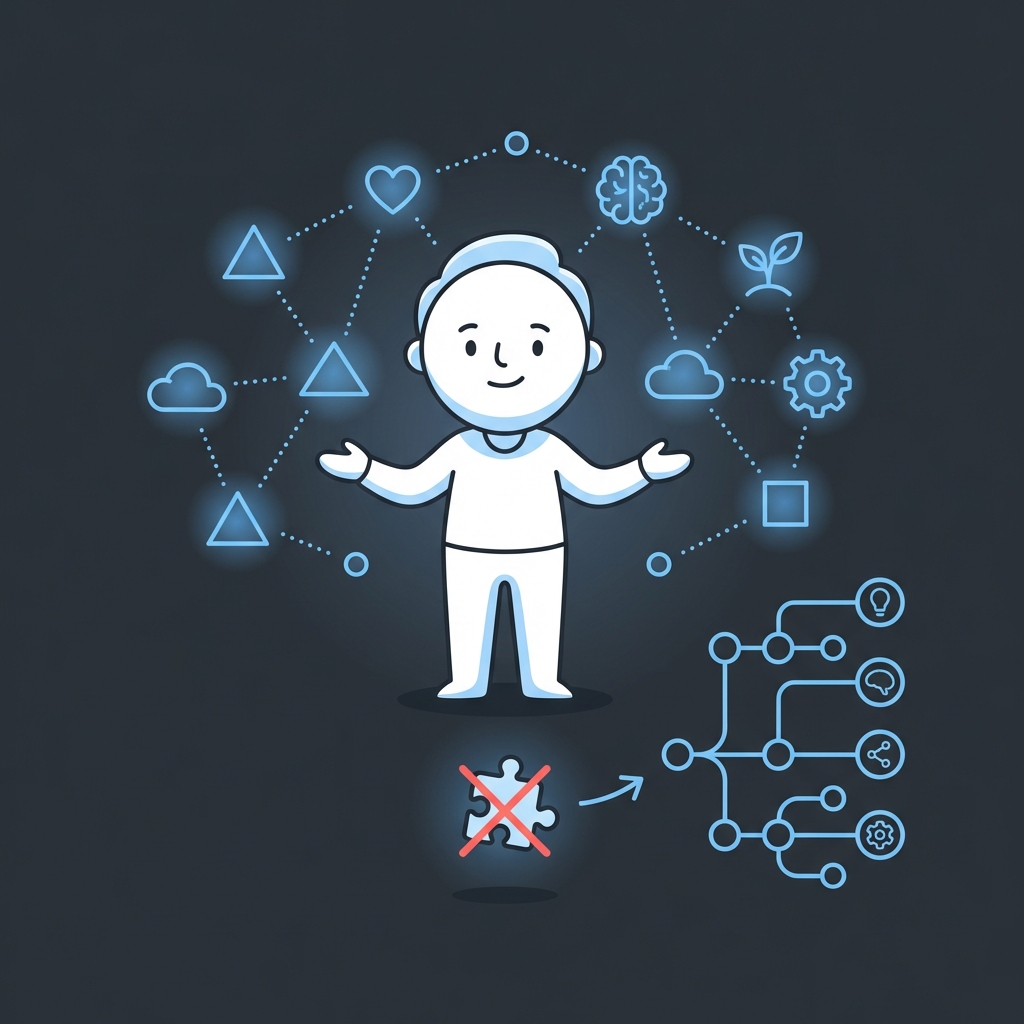
The productivity world loves a clean problem. “Get better sleep.” “Exercise more.” “Be more present with your kids.” Each goal arrives with its own guru, its own method, its own promise that this—finally—is the key to unlocking your best life.
It feels so manageable, doesn’t it? Pick one thing. Focus. Execute. Win.
Except you’re not one thing. You’re a whole person living in an interconnected web of responsibilities, relationships, and needs that refuse to stay in their assigned lanes. When you try to optimize one piece of your life in isolation, the rest of your system pushes back in ways that catch you completely off guard.
The Seductive Lie of Single-Domain Solutions
There’s something deeply appealing about advice that treats you like a machine with one broken part. Sleep better, and everything else will fall into place. Meal prep on Sundays, and your week will run smoothly. Set boundaries at work, and suddenly you’ll have energy for your family.
The appeal isn’t just simplicity—it’s the promise of control. If your problem can be contained to one domain, then the solution feels achievable. You can point to a specific behavior, track a specific metric, and feel like you’re making progress.
But here’s what happens in practice: You start waking up at 5 AM to exercise, and it works beautifully for two weeks. You feel energized, accomplished, proud. Then your kid gets sick and needs you at night. Or a work deadline hits and you’re staying up later. Suddenly that 5 AM alarm becomes torture, and you’re more exhausted than when you started.
The advice didn’t fail because you lacked willpower. It failed because it assumed your exercise routine existed in a vacuum, disconnected from the dozen other moving parts of your actual life.
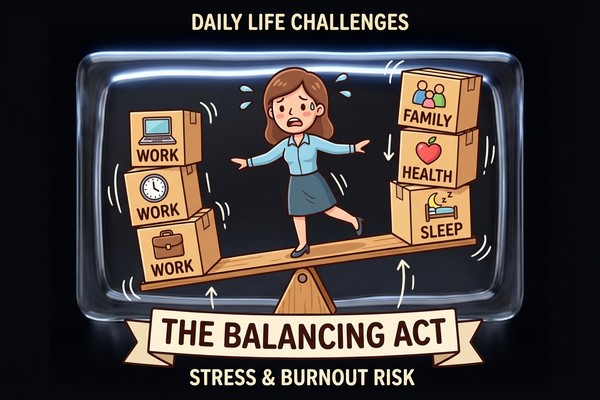
Most self-improvement content treats symptoms while ignoring the system. It’s like trying to fix a leak in your kitchen while ignoring the fact that your whole house is sinking.
The Hidden Web of Dependencies
Your life domains aren’t separate buckets—they’re more like a spider web where touching one strand makes the whole thing vibrate. Sleep affects your patience with your kids. Your patience affects your relationship. Your relationship affects your stress levels. Your stress affects your work performance. Your work performance affects your sleep.
Take something as simple as cooking dinner. The productivity advice says: meal prep, batch cook, optimize your kitchen setup. But cooking dinner isn’t just about food—it’s about the mental load of planning meals your family will actually eat, the emotional labor of managing everyone’s preferences and dietary needs, the time squeeze between work and bedtime routines, and the energy you have left after everything else.
When you’re exhausted from work, cooking feels impossible. When you order takeout instead, you feel guilty about money and nutrition. When you feel guilty, you’re less patient with your family. When you’re less patient, bedtime becomes a battle. When bedtime is a battle, you stay up later trying to decompress. When you stay up later, you’re more exhausted tomorrow.
The problem isn’t that you can’t follow through—it’s that you’re trying to solve a systems problem with a single-point solution.
This is why that exercise routine fell apart the moment other demands appeared. It wasn’t integrated into your life; it was balanced precariously on top of it. And when life shifted—as it always does—the whole thing toppled.
The Guilt Tax of Partial Optimization
Here’s something nobody talks about: when you successfully improve one area of your life, you often feel worse, not better. You start exercising consistently, but now you’re acutely aware of how little you’re reading. You get your work schedule under control, but suddenly the state of your house feels overwhelming.
This isn’t ingratitude or perfectionism—it’s your system responding to imbalance. When you pour energy into one domain, that energy has to come from somewhere else. Your attention is finite. Your willpower is finite. Your hours are definitely finite.
The guilt appears because you’re treating yourself like you should be able to optimize everything simultaneously, when the reality is that life is about tradeoffs. Sometimes work gets more of your energy, and your house gets less. Sometimes your family needs you more, and your side project gets less. Sometimes your health requires attention, and your social life gets less.
The productivity culture doesn’t prepare you for this reality. It sells you the fantasy that the right system will let you excel everywhere at once. When that doesn’t happen—when improving one area highlights the gaps in another—you assume you’re doing something wrong.
Reframing: You’re a Portfolio, Not a Problem
What if instead of trying to optimize individual life domains, you thought of yourself as managing a portfolio? In investing, you don’t expect every stock to perform perfectly all the time. You expect some to be up when others are down. You rebalance periodically. You make strategic decisions about where to allocate resources based on your current season and long-term goals.
Your life works the same way. Sometimes your career needs more investment. Sometimes your health does. Sometimes your relationships do. The goal isn’t perfect balance—it’s conscious allocation based on what matters most right now and what’s sustainable long-term.
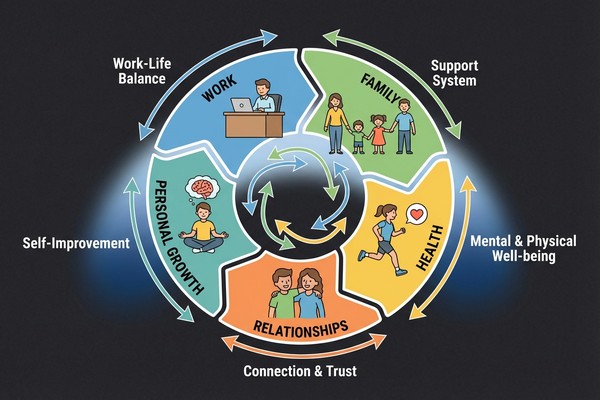
This reframe changes everything. Instead of feeling guilty that you can’t maintain peak performance in every area, you start making intentional choices about where to focus your limited resources. Instead of seeing dips in some areas as failure, you see them as the natural result of investing more heavily elsewhere.
A portfolio approach also helps you spot the real dependencies. You notice that when your sleep suffers, everything else becomes harder. You realize that when your relationship is solid, you can handle more stress at work. You see that when you’re physically healthy, you have more patience for the mental load of family life.
Mapping Your Interconnected Reality
Try this: Write down your top five life domains. Maybe they’re work, family, health, friendships, and personal growth. Maybe they’re different. Now draw lines between them showing how they influence each other.
Where do you see positive feedback loops? (Better sleep → more patience → better relationships → less stress → better sleep)
Where do you see conflicts? (Work travel → disrupted routines → family stress → guilt → work distraction)
What are your keystone domains—the ones that, when they’re going well, make everything else easier?
This isn’t an academic exercise. It’s a map of how change actually works in your life. When you understand the connections, you can make smarter choices about where to intervene and what tradeoffs you’re willing to make.
You’re not broken because single-domain solutions don’t stick. You’re human because your life is beautifully, messily interconnected.
Building for the Whole You
This is why most productivity tools feel like they’re missing something. They’re built for the fantasy version of you—the one who has clean goals that don’t interfere with each other, unlimited willpower, and a life that stays predictably stable.
The real you needs tools that understand the web of dependencies. Tools that help you see the ripple effects of your choices. Tools that support you in making conscious tradeoffs rather than pretending tradeoffs don’t exist.
The real you needs systems that account for the fact that some weeks, keeping everyone fed and showing up to work is victory enough. Other weeks, you might have bandwidth for bigger goals. Both are valid. Both deserve support.
Most importantly, the real you needs permission to stop treating yourself like a collection of separate problems to solve. You’re a whole person living a whole life. The goal isn’t to optimize every piece—it’s to create a sustainable, conscious way of moving through the world that honors all of who you are.
When you stop trying to fix yourself one domain at a time and start managing yourself as an integrated system, something shifts. The guilt lessens. The pressure eases. And paradoxically, you often find that sustainable change becomes not just possible, but natural.
Because you’re finally working with your reality instead of against it.
This article was created with collaboration between humans and AI—we hope you ❤️ it.