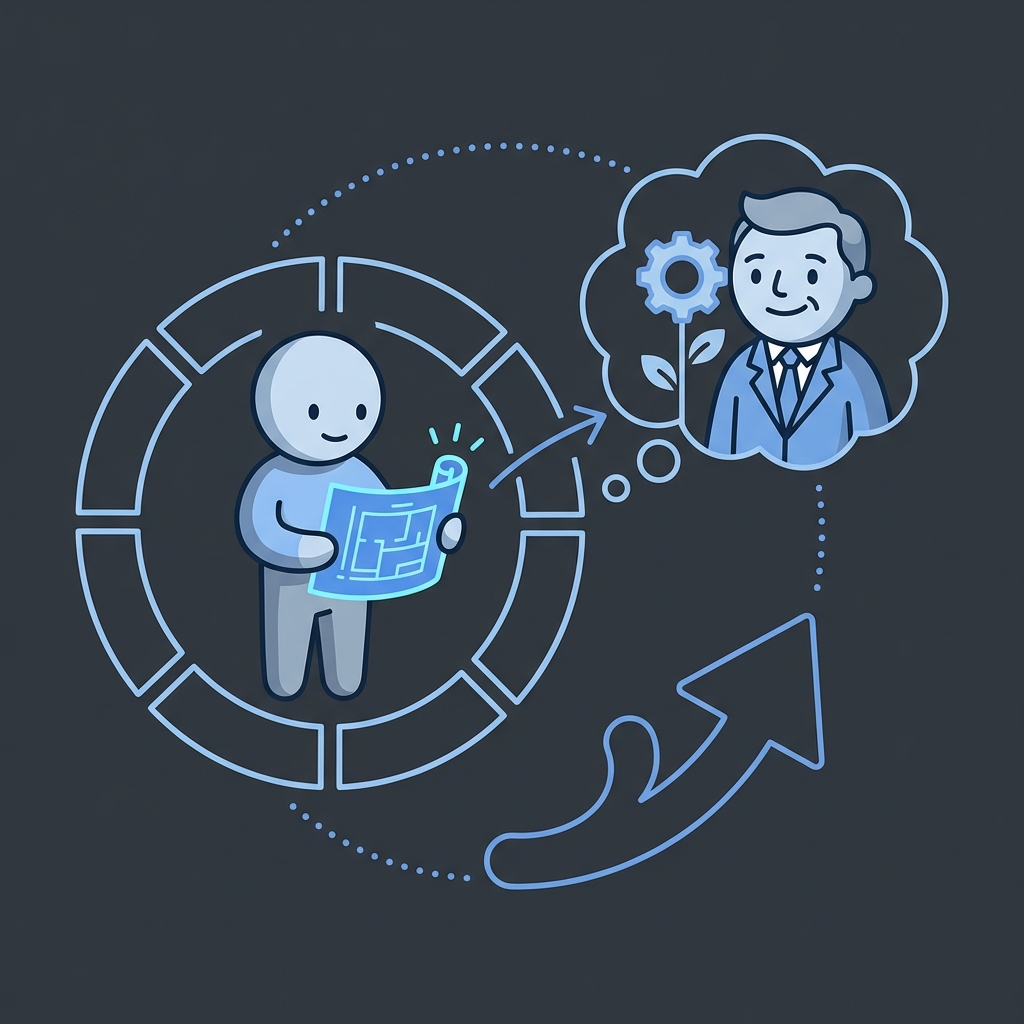
There’s a person you’ve never met who depends on you completely. They inherit every decision you make, every task you postpone, every system you neglect to build. They live with the consequences of your overwhelm, your shortcuts, your well-intentioned chaos. This person is your future self—and they deserve better than what most of us give them.
We talk about planning like it’s about control, about getting ahead, about optimization. But that framing misses something essential. Planning isn’t about controlling outcomes you can’t predict. It’s about caring for someone who will have to live inside the reality you’re creating right now.
The Stranger Who Lives Your Life
Your future self isn’t an abstract concept. They’re a real person with real needs who will wake up in six months, or next year, or next week, and have to navigate whatever landscape you’ve left them. They’ll open your email inbox. They’ll look at your calendar. They’ll try to remember what you promised, what you started, what you meant to follow up on.
When you’re drowning in today’s urgency, it’s easy to forget this person exists. But they’re always there, waiting in the wings, hoping you’ll remember they have to live in this body, in this life, with these responsibilities.
Most productivity advice treats future-you like a more efficient version of current-you—someone who will magically have more energy, better systems, clearer priorities. But future-you is just you, transported forward in time, probably just as tired, probably dealing with new complexities you can’t even imagine yet.
The kindest thing you can do for future-you isn’t to plan their perfect life. It’s to not leave them a mess to clean up.

The Debt We Don’t Talk About
Every time you say “I’ll deal with that later,” you’re making a withdrawal from future-you’s account. Not just their time—their mental energy, their peace of mind, their capacity to handle whatever new challenges arise.
This debt accumulates in ways we rarely acknowledge. The doctor’s appointment you keep postponing becomes an urgent health issue future-you has to navigate while also managing a work crisis. The conversation you avoid having with your partner becomes a relationship repair project future-you inherits during an already stressful season. The financial paperwork you shove in a drawer becomes a tax-time nightmare for someone who’s older, more tired, and dealing with whatever complexity next year brings.
Sometimes “I’ll handle it later” is pure survival. When you’re in crisis mode, when you’re barely keeping your head above water, deferring things isn’t laziness—it’s triage. But even in survival mode, it’s worth acknowledging the cost. Future-you will pay it, and they deserve your compassion for that burden, not your judgment.
The cruelest part is how this debt compounds. Future-you doesn’t just inherit your postponed tasks—they inherit them while also trying to manage whatever new demands have emerged. They get your old chaos plus their new complexity. It’s like trying to clean a house that’s still actively being lived in by someone who never puts anything away.
When Care Looks Like Planning
Real planning—the kind that serves future-you—doesn’t look like color-coded calendars or elaborate systems. It looks like sitting down once a week and asking: “What is the person who will live my life next month going to need from me?”
This isn’t about creating the perfect schedule. It’s about creating conditions where future-you can function without constantly cleaning up your messes. It’s about leaving them context, not just tasks. It’s about giving them choices, not just obligations.
Ten minutes. Once a week. That’s often enough to transform the landscape future-you will inherit. Not because you can predict what will happen, but because you can reduce the cognitive load they’ll carry when it does.
Planning is love in action. It’s saying to future-you: “I see that you’re going to have to live with these decisions, and I care about making that easier.”
Three Gifts for Future-You
The most generous thing you can do for future-you isn’t to solve all their problems. It’s to give them three specific gifts that make any problem more manageable.
Clarity. Future-you shouldn’t have to decode what past-you was thinking. When you write something down, include the context. When you make a decision, note why. When you start something, capture what success looks like. Future-you lives in a different mental space than you do right now—they need breadcrumbs, not puzzles.
Buffers. Future-you will face unexpected demands, just like you do. The difference is whether they face them with margin or without it. This means leaving space in calendars, keeping some money uncommitted, not scheduling every minute of every day. Buffers aren’t wasted time—they’re insurance policies for someone who can’t predict what they’ll need to handle.
Fewer open loops. Every unfinished project, every “I should follow up on that,” every half-started initiative is a weight future-you carries in their mind. You can’t complete everything, but you can consciously choose what to keep open and what to close. Sometimes the most loving thing you can do for future-you is to officially abandon something that’s been draining energy for months.

The Question That Changes Everything
Here’s the question that cuts through all the productivity noise: What is future-you begging you to simplify right now?
Not optimize. Not improve. Not make more efficient. Simplify.
Maybe it’s the subscription services you never use but keep meaning to cancel. Maybe it’s the social obligation that drains you every month but feels too awkward to address. Maybe it’s the project that seemed important six months ago but no longer serves your actual life.
Future-you doesn’t need you to be perfect. They need you to be honest about what’s actually sustainable, what’s actually serving you, what’s actually worth the mental real estate it’s occupying.
This question bypasses the productivity trap entirely. It’s not about doing more or doing it better. It’s about recognizing that complexity itself has a cost, and future-you is the one who pays it.
The Systems That Remember So You Don’t Have To
The most profound gift you can give future-you is systems that hold context without requiring your constant attention. Not because systems are inherently good, but because good systems free future-you from having to remember what you were thinking, what you promised, what you started.
This is where most productivity tools fail future-you. They optimize for input—faster capture, better organization, more features. But they don’t optimize for output—making it easier for future-you to understand what matters, what’s waiting, what needs attention.
Future-you needs tools that remember not just what you wrote down, but why it mattered. They need systems that surface the right information at the right time without requiring them to maintain complex organizational schemes. They need technology that reduces their mental load rather than adding to it.
The best system for future-you is the one that works even when you’re tired, distracted, or dealing with something completely unexpected.
Most of us leave future-you systems that only work when they’re at their best—fully focused, well-rested, operating at peak capacity. But future-you, like current-you, will have bad days, overwhelming seasons, moments when they can barely keep up with the basics.
The systems that truly serve future-you are designed for their worst days, not their best ones. They work when future-you is sick, stressed, or simply human. They don’t require perfect maintenance or constant optimization. They just quietly hold what matters until future-you needs it.
The Radical Act of Care
In a culture that worships productivity and optimization, treating future-you as a stakeholder is almost radical. It means admitting that you can’t control outcomes, but you can influence conditions. It means choosing care over performance, sustainability over sprint.
It means recognizing that the person who will live your life tomorrow, next week, next year deserves the same consideration you’d give any other person you love. They deserve clarity, margin, and the gift of problems that don’t compound unnecessarily.
Future-you isn’t asking for perfection. They’re asking for thoughtfulness. They’re asking you to remember, when you’re making decisions in the urgency of now, that someone will have to live with those decisions later. And that someone is worth caring about.
This article was created with collaboration between humans and AI—we hope you ❤️ it.