
There’s a moment that happens in therapy sessions, parenting groups, and late-night conversations with friends. Someone describes feeling overwhelmed, stretched thin, carrying too much alone. The listener offers the most obvious solution: “Why don’t you just ask for help?” And something shifts in the room. The person asking for advice suddenly looks uncomfortable, defensive, or defeated.
That reaction tells you everything. Asking for help isn’t a skill problem—it’s a story problem. We all carry invisible rules about when it’s okay to need support, who deserves it, and what asking says about us. These rules were written long before we knew we were learning them.
The Classroom of Childhood
Your relationship with asking for help was shaped in your earliest classroom: your family. Maybe you watched a parent struggle in silence, martyring themselves to keep everyone else comfortable. Perhaps you learned that needing help meant being weak, burdensome, or failing at the basic task of being human.
Some families treated requests for support like emergencies—something had to be desperately wrong before you could reach out. Others made help conditional, available only if you’d already exhausted every other option or proven your worthiness through suffering. Still others offered help so freely that asking became complicated by guilt, obligation, or the fear of being seen as taking advantage.
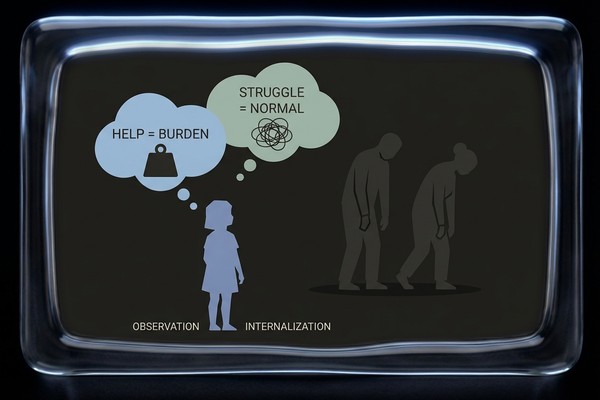
The messages weren’t always spoken directly. You absorbed them from watching who got support and who didn’t, whose needs were taken seriously and whose were dismissed. You learned from the tone that greeted requests, the conditions attached to assistance, and the stories told about people who asked “too much” or “too often.”
These early lessons created your personal constitution around help—a set of unwritten laws that still govern your behavior decades later. The problem is, you probably didn’t choose these rules. You inherited them.
The Rules You Live By
Most of us carry some version of these inherited rules without realizing it. You might believe that asking for help is admitting defeat, that capable people figure things out alone, or that your needs are inherently less important than everyone else’s. Maybe you’ve internalized the rule that help must be earned through prior suffering, or that accepting support creates debts you can never fully repay.
Some people learn that asking for help is manipulative—a way of avoiding responsibility or taking advantage of others’ kindness. Others absorb the message that needing support is temporary and shameful, something to minimize and apologize for rather than acknowledge as a normal part of being human.
The rules we learned about asking for help were written by people who had their own complicated relationships with needing support.
These rules might have made sense in the context where you learned them. If your family was stretched thin financially or emotionally, teaching children to be self-reliant might have been a survival strategy. If someone in your household weaponized helplessness or used requests for support to manipulate others, learning to be suspicious of asking might have been protective.
But rules that served you in one context can become prisons in another. The self-reliance that helped you survive childhood might now be isolating you as an adult. The hypervigilance about being a burden might be preventing you from building the support systems you actually need.
How Yesterday’s Rules Shape Today’s Struggles
These inherited rules don’t stay quietly in the background. They show up in how you approach challenges, navigate relationships, and respond to your own needs. You might find yourself working twice as hard to avoid asking for help, or feeling guilty and anxious when you finally do reach out.
Maybe you’ve noticed that you can offer support to others easily but struggle to accept it when it’s offered to you. Or perhaps you’ve developed elaborate systems to manage everything alone, then feel resentful when others seem to navigate life with more ease and less isolation.
The rules might show up as that voice in your head that immediately starts problem-solving when someone offers help, explaining why their solution won’t work or why you should handle it yourself. They appear in the way you apologize excessively when asking for support, or in how you try to minimize your needs to make them more palatable.
Some people find themselves only asking for help in crisis situations, when the alternative is complete breakdown. Others discover they’ve become so uncomfortable with needing support that they’ve organized their entire lives around avoiding it—choosing careers, relationships, and living situations that minimize their dependence on others.
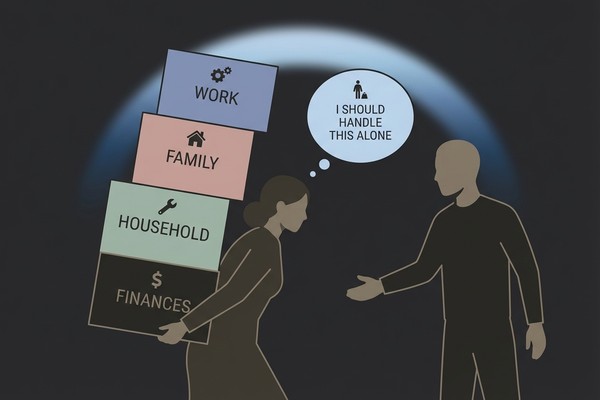
The cost of these patterns extends beyond personal exhaustion. When we can’t ask for help, we rob others of the opportunity to support us. We miss chances to deepen relationships, build community, and model healthy interdependence for the people who look up to us.
The Hidden Price of Going It Alone
Living by rigid rules about help creates a particular kind of suffering. It’s not just the practical burden of carrying too much alone—though that’s real. It’s the emotional isolation that comes from believing your needs are somehow different, less valid, or more burdensome than everyone else’s.
When you can’t ask for support, you start to feel fundamentally separate from other people. You watch them navigate challenges with apparent ease while you struggle in silence. You begin to believe that everyone else has figured out something you haven’t, that they’re more capable or deserving of support than you are.
This isolation feeds on itself. The longer you go without asking for help, the more foreign and frightening it becomes. Your skills for reaching out atrophy from disuse. You lose touch with how normal it is to need support, how willing most people are to offer it, and how much connection can grow from honest exchanges of help.
The stories we tell ourselves about asking for help often hurt us more than the original situations that created them.
The resentment that builds from carrying too much alone can poison relationships and opportunities. You might find yourself frustrated with partners, friends, or colleagues who seem to ask for support easily, envying their ability to reach out while simultaneously judging them for needing help. This creates a lose-lose dynamic where you’re isolated by your self-reliance and bitter about others’ willingness to be interdependent.
Rewriting the Rules That No Longer Serve
The beautiful thing about inherited rules is that you can examine them, question them, and choose which ones still fit your life. Just because you learned that asking for help was dangerous, burdensome, or shameful doesn’t mean those beliefs have to govern your adult relationships.
Start by getting curious about your current patterns. Notice when you automatically default to handling things alone, even when support is available. Pay attention to the stories you tell yourself about what asking for help means, and where those stories might have originated.
Consider the possibility that your needs are as valid as anyone else’s, that asking for support can strengthen relationships rather than burden them, and that interdependence is a sign of wisdom, not weakness. Think about the people you most admire—chances are, they’ve learned to balance giving and receiving support in healthy ways.
The goal isn’t to become someone who asks for help constantly or inappropriately. It’s to develop a more flexible, conscious relationship with needing support. You want to be able to reach out when it would genuinely help, without the internal drama and self-judgment that make asking for help harder than the original problem.
A Small Experiment in Support
This week, try one small experiment with asking for help. Choose something lower stakes than usual—not the big crisis you’ve been managing alone, but something smaller and more manageable. Maybe ask a colleague to review a document, request that a friend pick up coffee on their way to meet you, or see if a neighbor can accept a package while you’re at work.
Notice what comes up for you in the asking. What stories does your mind tell about what this request means? What fears or judgments arise? Pay attention to how the other person responds, and how it feels to receive their support.
The point isn’t to prove anything or fix your relationship with help overnight. It’s simply to gather new data about what asking for support actually looks like in your current life, rather than relying on old assumptions formed in very different circumstances.
Most people discover that asking for help is far less dramatic than their internal rules suggest. The world doesn’t end, relationships don’t collapse, and people don’t suddenly see them as incompetent or burdensome. Instead, small requests often create opportunities for connection and reciprocity that enrich everyone involved.
Your relationship with asking for help is one of the most powerful factors in determining how much mental load you carry alone. The rules you inherited about needing support don’t have to be the rules you live by forever. You get to choose which beliefs serve your current life and which ones you’re ready to retire.
The question isn’t whether you need help—we all do. The question is whether you’ll give yourself permission to ask for it.
This article was created with collaboration between humans and AI—we hope you ❤️ it.