
There’s something almost absurd about the way we plan our weeks. We open our calendars, stare at Monday’s blank slate, and start filling it with optimism. By Wednesday, we’re playing defense. By Friday, we’re wondering where the week went and why nothing felt quite right.
The problem isn’t that we’re bad at planning. The problem is that we’re planning days instead of weeks—treating each 24-hour period like an independent unit when they’re actually chapters in a larger story. Your Tuesday doesn’t exist in isolation. It carries the weight of Monday’s chaos and sets the stage for Wednesday’s demands.
Most planning systems miss this entirely. They hand you a daily template and wish you luck, as if energy resets overnight and responsibilities don’t bleed across boundaries. But anyone who’s tried to tackle a demanding project on the same day as their kid’s school event knows better. Some combinations just don’t work, no matter how good your intentions.
The Whack-a-Mole Problem
Daily planning feels reactive because it is reactive. You wake up, check your list, and start swinging at whatever pops up. Urgent email here, forgotten deadline there, unexpected crisis over there. You’re not orchestrating your week—you’re responding to it.
This approach treats symptoms, not patterns. Yes, you handled today’s fire drill, but what about the conditions that created it? The meeting that always runs long on Tuesdays. The energy crash that hits every Thursday afternoon. The way Sunday’s family time gets squeezed when you don’t prep on Saturday.

When you plan day by day, you miss the rhythm of your week. You schedule demanding calls on days when you’re already stretched thin. You put creative work right after energy-draining activities. You treat Friday like any other day, ignoring the fact that your brain is already halfway to the weekend.
Your week has a natural rhythm. Daily planning fights against it instead of flowing with it.
The result is that constant feeling of being behind, even when you’re technically getting things done. You’re working against your week’s natural grain instead of with it.
Energy Isn’t Renewable Daily
Here’s what productivity culture gets wrong: energy doesn’t reset at midnight like some kind of video game health bar. It ebbs and flows across days, influenced by sleep, stress, social demands, and a dozen other factors you can’t always control.
Some days you wake up ready to tackle the world. Other days, you’re running on fumes before lunch. This isn’t a character flaw—it’s biology. Your energy is a weekly resource that needs to be managed across seven days, not optimized within each individual day.
Think about your own patterns. Maybe Mondays drain you because you’re processing the weekend transition and catching up on what accumulated. Maybe Wednesdays are your sweet spot—far enough from Monday’s chaos, not yet feeling Friday’s pull. Maybe Thursday afternoons are consistently rough because that’s when the week’s accumulated stress peaks.
These patterns aren’t random. They’re data. But daily planning systems ignore this data entirely, treating each day as if it exists in a vacuum. They ask you to be equally productive on your high-energy days and your recovery days, which is like asking a sprinter to maintain their 100-meter pace for a marathon.
The Load Peaks That Repeat
Every week has its predictable pressure points. School pickup on Mondays when you’re still catching up from the weekend. The standing meeting that always runs long on Tuesdays. The travel day that wipes out Thursday’s productivity. The social commitments that make Sunday evening feel rushed.
These aren’t exceptions—they’re features of your week’s landscape. Yet most planning systems treat them like surprises every single time. You schedule important calls right after the draining meeting. You put creative work on the day you travel. You plan an ambitious evening routine for the night you always have family commitments.
The weekly view reveals these patterns clearly. You start to see that certain combinations consistently create stress. That some transitions are harder than others. That your energy and attention have predictable peaks and valleys that repeat week after week.
Once you see these patterns, you can plan around them instead of through them. You can build buffers before the intense days. You can batch similar activities when your energy aligns. You can stop fighting your week’s natural structure and start working with it.
Mapping Your Weekly Story
A week isn’t seven separate days—it’s one continuous story with peaks, valleys, transitions, and recovery periods. Understanding this story is the key to planning that actually works.
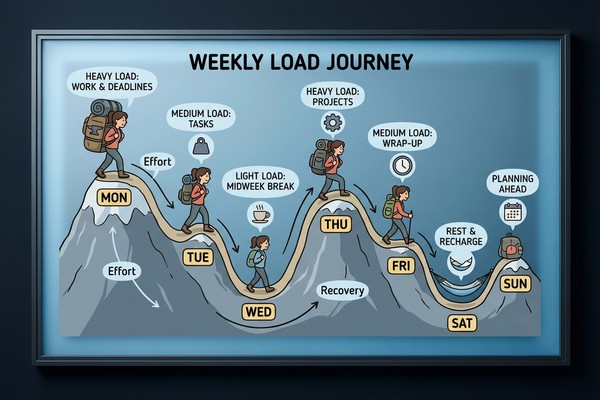
Start by identifying your weekly anchors—the non-negotiable commitments that define your week’s structure. These might be work meetings, school schedules, family time, or personal routines that you protect. Your anchors create the framework around which everything else flows.
Next, map your energy patterns. Which days consistently feel high-energy? Which ones are naturally slower? When do you hit your creative peak? When do you need recovery time? This isn’t about optimizing—it’s about recognizing what already exists.
Then notice your transition points. Monday morning’s startup sequence. Wednesday’s midweek recalibration. Friday afternoon’s wind-down. These transitions need space and attention, not just more tasks piled on top.
Finally, identify your load peaks—the predictable pressure points where multiple demands converge. These aren’t problems to solve but realities to plan around. You can’t eliminate them, but you can avoid scheduling additional complexity during these times.
The goal isn’t to optimize every day. It’s to create a week that flows instead of fights.
Choosing One Focus Without Dropping Everything
The weekly lens makes prioritization clearer because you can see the whole picture. Instead of asking “What’s most important today?” you can ask “What’s the one thread that needs to run through this week?”
This doesn’t mean ignoring everything else. It means choosing one primary focus that gets protected time and attention across multiple days, while other responsibilities get managed around it. Your weekly focus might be a project that needs sustained attention, a relationship that needs nurturing, or a personal goal that requires consistent progress.
The key is choosing one focus that can adapt to your week’s natural rhythm. If your focus is creative work, you might do the heavy thinking on your high-energy days and the editing on your lower-energy ones. If your focus is relationship building, you might have deeper conversations when you have space and quick check-ins when you’re pressed for time.
This approach acknowledges that not every day can be equally productive toward your main goal, but every day can contribute something. Some days you sprint, some days you walk, some days you rest—but you’re always moving in the same direction.
Finding Your Weekly Anchor Points
Take a moment to think about your typical week. What are the fixed points that everything else revolves around? These might be obvious commitments like work hours and family time, or subtler rhythms like your creative peak hours or the day you naturally want to tackle household tasks.
Your anchor points aren’t just calendar items—they’re the energy and attention patterns that define how your week actually unfolds. The day you naturally want to plan ahead. The evening you consistently need downtime. The morning you’re most likely to tackle challenging conversations.
Once you identify these anchors, you can build your week around them instead of against them. You can schedule demanding work during your natural focus periods. You can protect recovery time after intense days. You can batch similar activities when your energy and context align.
The goal isn’t to optimize these patterns but to respect them. Your week already has a natural structure—the key is learning to see it and work with it.
Systems That See Your Whole Week
This is where most planning tools fall short. They’re built around the daily view because that’s how calendars work, but your life doesn’t happen in daily chunks. You need systems that can hold the complexity of a full week while still helping you navigate each individual day.
The best weekly systems don’t try to control every detail. Instead, they help you see patterns, protect what matters most, and make adjustments as the week unfolds. They recognize that planning is ongoing conversation between your intentions and reality, not a one-time decision made on Sunday night.
These systems understand that some weeks will be smooth and others will be chaotic, but both can be successful if you’re working with your natural rhythms instead of against them. They help you hold the big picture while staying present for today’s demands.
The week is your smallest complete planning unit. Everything else is either too narrow or too broad to be actionable.
Your week is one story, not seven separate chapters. When you start planning from this perspective, everything changes. You stop fighting your natural rhythms and start flowing with them. You stop treating each day like a blank slate and start seeing the connections that already exist.
The result isn’t perfect weeks—it’s sustainable ones. Weeks that feel intentional instead of reactive. Weeks where you’re the author of your story, not just a character responding to whatever happens next.
This article was created with collaboration between humans and AI—we hope you ❤️ it.